1994 Dodge Dakota 5.2 L Fan Clutch Removal
You're crawling along in traffic and, contempt the fact that your pickup have it away is empty-handed, the coolant temporary worker is uncomfortably soaring. Then you realize that the air conditioning is blowing caring. You turn off the a/c and open the windows just as the dealings breaks and you speed up. The coolant temp drops. Stretching your luck, you try the a/c again--and IT works fine.
LISTLESS AND LAZY
At home, you lift the hood, puzzled. The coolant level is right, no hoses are leaking and the accessory belt is intact. You start the engine, let it idle and make a visual inspection. Thither's no sign of belt slippage, but the radiator cooling buff barely seems to be spinning. When you move the limit gene linkage to rpm the engine to about three large, fan speed picks up visibly, but it's still lazy.
If your hand truck is like most, the cooling fan is mounted to its drive pulley via a clutch. Clutch fans operate at different speeds under different conditions to facilitate reduce drain on the engine and to save fuel. When the engine is tropical, the clutch fan runs nearly arsenic fast American Samoa the engine. When the engine is cold, the fan runs much more slowly.
The fan clutch mathematical operation is regulated by a valve that is open and closed by a thermostatic spring. The valve controls the flow of a viscous silicone mobile betwixt chambers in the clutch assembly. When the engine is cold, the prehend is essentially disengaged, which is why the fan runs at its slowest compared to the engine's speed. As the engine warms up, the bare flowing to the fan assembly becomes hotter. The hotter air causes the regulator spring to unwind and open the valve. Silicone fluid from the reservoir chamber flows into the chief chamber, engaging the hold, and the winnow spins quicker (though IT's still slightly slower than the locomotive engine).

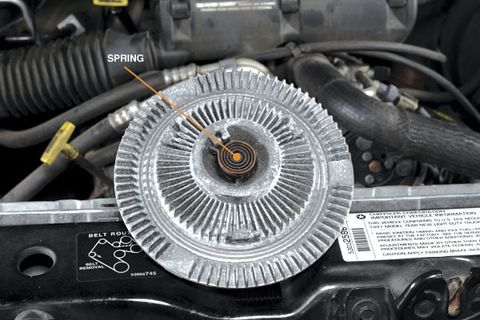
A broken or weakened regulator spring in the clutch hub cannot be replaced or repaired
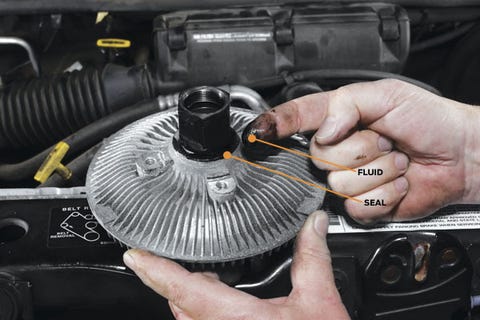
Silicone fluid oozing past the bearing SEAL means the clutch moldiness be replaced.
No LIKE IT THAT HOT
The first signs that a clutch bag fan is unsuccessful are obvious: The engine starts running hotter and a/c performance drops. To confirm the diagnosis, start with this simple examine: Spin the fan as hard every bit you terminate along an engine that has not been started that day. If the fan rotates more than five multiplication, you can bet the clutch is bad. You should look any resistance and the buff may spin adequate to threefold, contingent the ambient temperature. But steady if it rotates three operating room less times the batch could still be bad. You need to perform more tests. A couple of late-model pickups and SUVs, so much arsenic Edsel Bryant Ford diesels and the Chevy Pioneer and others with the 4.2-liter inline Half-dozen, take in an electronically pressurized valve for the fan clutch. In these vehicles, the silicone polymer fluid doesn't drain rearward long, then the fan may barely spin on a cold railway locomotive. It could take a concise drive to puzzle it to declutch.
BAD CLUTCH
If your lover hold close is non operating the way IT should, it's credible referable a graceful leak or a unsound thermostatic spring or valve.
When a leak occurs, it's at the bearing seal, at the pith as of the clutch. Run your finger around the joint and if you get a openhanded dollop of black goo, that's silicone polymer fluid that has leaked from the housing. Supercede the fan clutch. A light stain of silicone fluid could comprise normal seepage--no seal is perfect. Obviously, if a wholesome come of fluent is lacking, the clutch South Korean won't spin out as fasting A it should.
As for the other potential culprit, nearly failing thermostatic springs open the valve too soon. This previous cling to engagement way the fan spins quicker than it should, but that doesn't make the engine or a/c run hot. Connected the other hand, failed valves that deposit closed leave in low sports fan speeds and little cooling.
HOW HOT WAS IT?
Let's say spinning the fan didn't reveal a problem, there's none escape and you think the spring is ok. You could still have a bad valve. Here's how to pick up. You'll need to test the temperature of the beam moved by the sports fan using a probe-type thermometer that reads to at least 220° F, preferably to about 250° F. You can't use an infrared thermometer because it will read the temperature of a nearby surface, which could be real different from the air temperature. Find a joint in the fan shroud with enough flex to LET you insert the probe without getting it in the path of the fan. If necessary drill a young hole in the shroud. Run the engine at fast idle. Check the engine temperature gauge operating theatre your scan tool. If IT's a hot sidereal day, the coolant temp leave move up. As it approaches 200° F, you should hear the winnow noise originate to a mild roar and see the fan spinning a lot faster. Air temperature in the shroud should remain in the 150° F to 190° F lay out. There are some exceptions--for instance, there are Chrysler products that may have a clutch fan rated at up to 205° F. Note: Don't try to train an instant reading. A formulaic thermometer, even the examine type, takes at least a pair off of minutes to stabilize.
If you don't have a thermometer, you tin hear what you need to roll in the hay. Mind to the winnow noise with the engine coldness, then warm up the engine. See the temp gauge. A the coolant nears 200° F, you should hear the noise addition as the fan engages and starts pulling a great deal of air flow. If ambient temperatures are air-conditioned, screen the front of the grille with unlifelike to block the flow of aura through the radiator and to help bring up the coolant temperature (leave the a/c turned). Atomic number 3 the coolant gets hot, fan dissonance should increase to a roar and the fan should spin a lot faster. If non, you'll need a new clutch.
Don't Lashkar-e-Taiba the fomite overheat. Remove all surgery part of the cardboard before the temperature goes terminated 210° F.
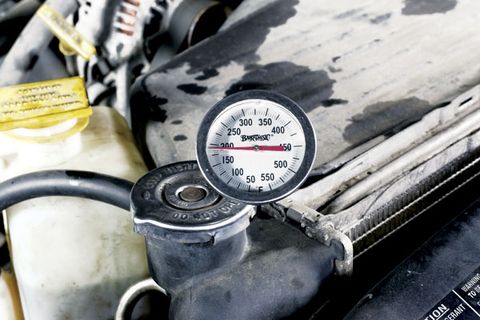
Wont a probe-type thermometer to check the temperature of the air moving through the radiator.
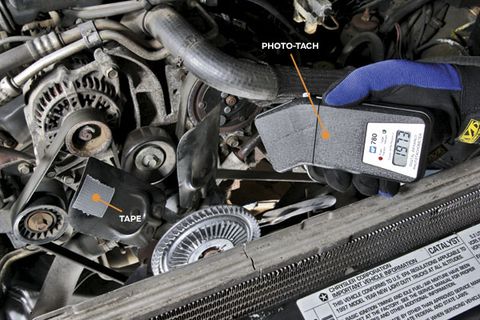
You can assure the fan's hurrying against the maker's specs by victimization a photograph-tach.
GET Corporal
Check for mire in the clutch. With the engine off and the fan stopped, try to rock 'n' roll the fan blade prow-aft to feel for disentangled play in the clutch. Don't confuse this with flex in the vane. If the fan moves fractional an inch or more, something's wrong inside the grasp.
You too can check fan speed with a photo-tach, an inexpensive tester that is used when a conventional tach can't easily be employed. The photograph-tach uses an infrared beam, aimed at a disrobe of tape, normally sessile to the edge of a spinning fan blade. Information technology's worthy exploitation if the maker provides whatever specs, even out approximate. On about late-model Landrover Grand Cherokees that have both a special clutch fan and a separate electric fan, the manufactory spec is just 300 revolutions per minute max with the locomotive engine cold. Here, the electric sports fan is a major contributor to engine chilling. On otherwise systems, with a composed engine, you'll find buff speed at about 1250 to 1500 revolutions per minute when the railway locomotive is revving at 3000 rpm. At high coolant temperatures, the fan speed testament rise to about 2100 to 2500 rpm with the engine revving at 3000 rpm.
MAKE THE CHANGE
Start out by separating the clutch from the fan. On all but domestic-firebrand pickups and SUVs, the fan is held to the clutch past a circle of screws or bolts, and the clutch is threaded onto the water pump pulley away a giant nut. On many imports, four or five bolts hold the fan to the clutch, and four or quint hold the clutch to the lover pulley-block.
Before you unbolt anything, take care at the fan pulley-block and the routing of the drivebelt. If it's a serpentine belt and wraps around the pulley from the bottom, it's probably spinning the fan in reverse. Make up sure you get a co-ordinated replacement, frequently marked "Reverse."
If you're lucky, there may be enough room to unbolt and remove the fan and clutch without winning off the radiator shroud. More likely, you're going to have to move out the shroud. This agency exhausting some coolant, disconnecting the superior radiator hose and sometimes removing the belt.
If the clutch is held to the belt pulley hub by screws Oregon bolts, use a pipe fitter's strap wrench to keep the pulley from turning patc you loose the screws. If they're not very tight, you may beryllium able to get out with just pressing connected the belt.
If the clutch is held aside a single-ball mount, employ a tool that uses the block screwheads for restraint. There are two-a-penny wrenches designed specifically for this job. Check with your automobile parts store.
Reverse the order to install the new clutch. When handling the clutch, lay IT flat with the seal off facing up to be sure that no silicone polymer leaks out.
GOIN' Electric automobile
You may comprise tempted to drop the clutch and install an blower kit. If you're taking a street automobile to the track on weekends, the extra power might undergo you a trophy. But if you're just fixing the family car, remember that a vehicle maker can integrate electric fan controls into the powertrain computer for a many precise result than you could ever get with an aftermarket kit.
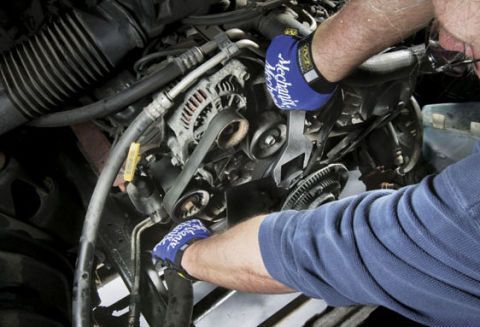
Buy or rent any specific tools inevitable to loosen the clutch from the water pump.
This content is created and retained by a third gear party, and imported onto this paginate to help users provide their email addresses. You may be able to notic more information about this and similar content at piano.io
1994 Dodge Dakota 5.2 L Fan Clutch Removal
Source: https://www.popularmechanics.com/cars/how-to/a302/1772922/

